
Application-configured platform
Mechanical commutation · compact precision motion
Graphite Brush Coreless Motors
Ironless-armature permanent-magnet DC motors delivering low inertia, smooth rotation and rapid response with straightforward graphite-brush commutation.
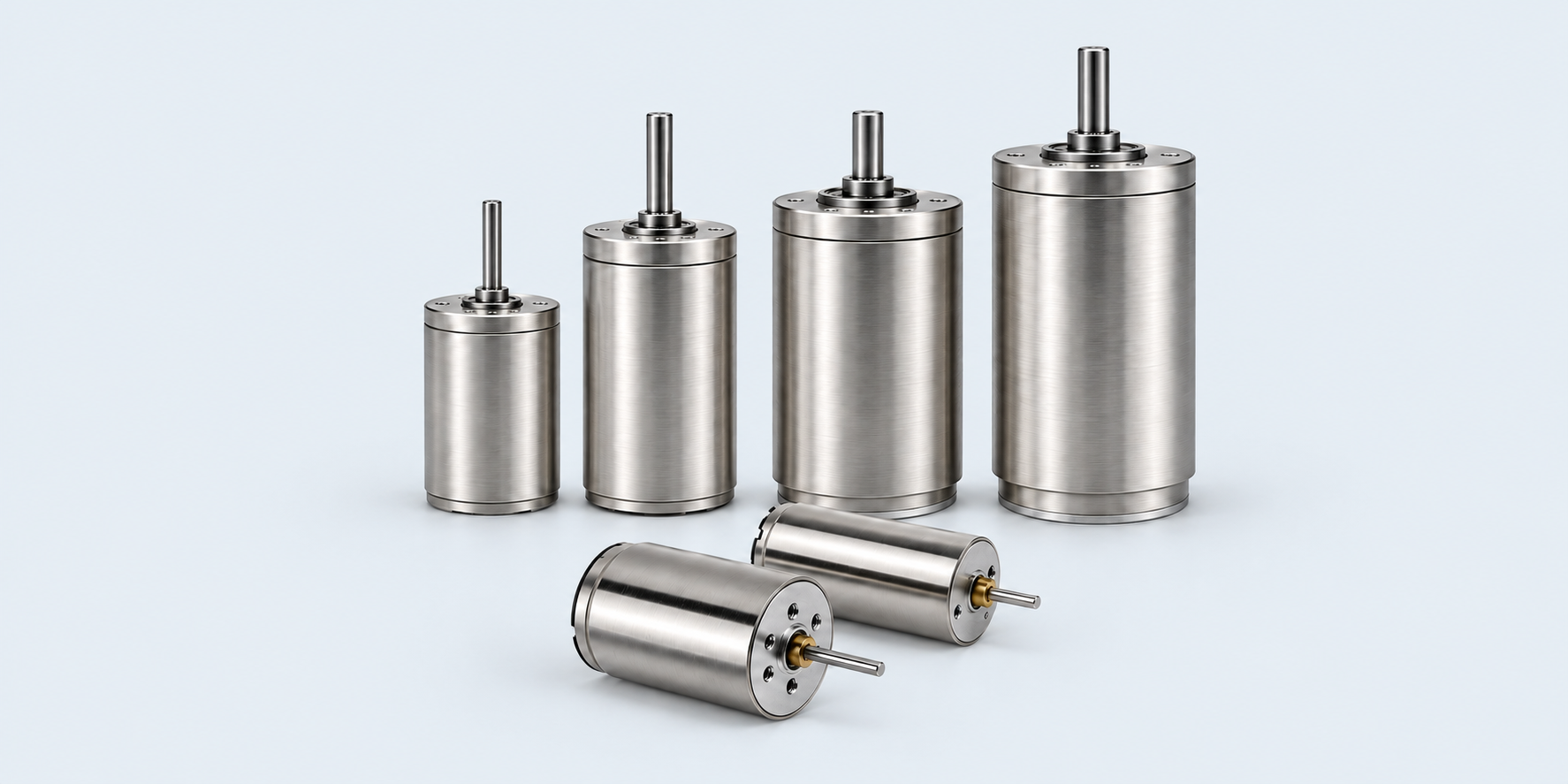
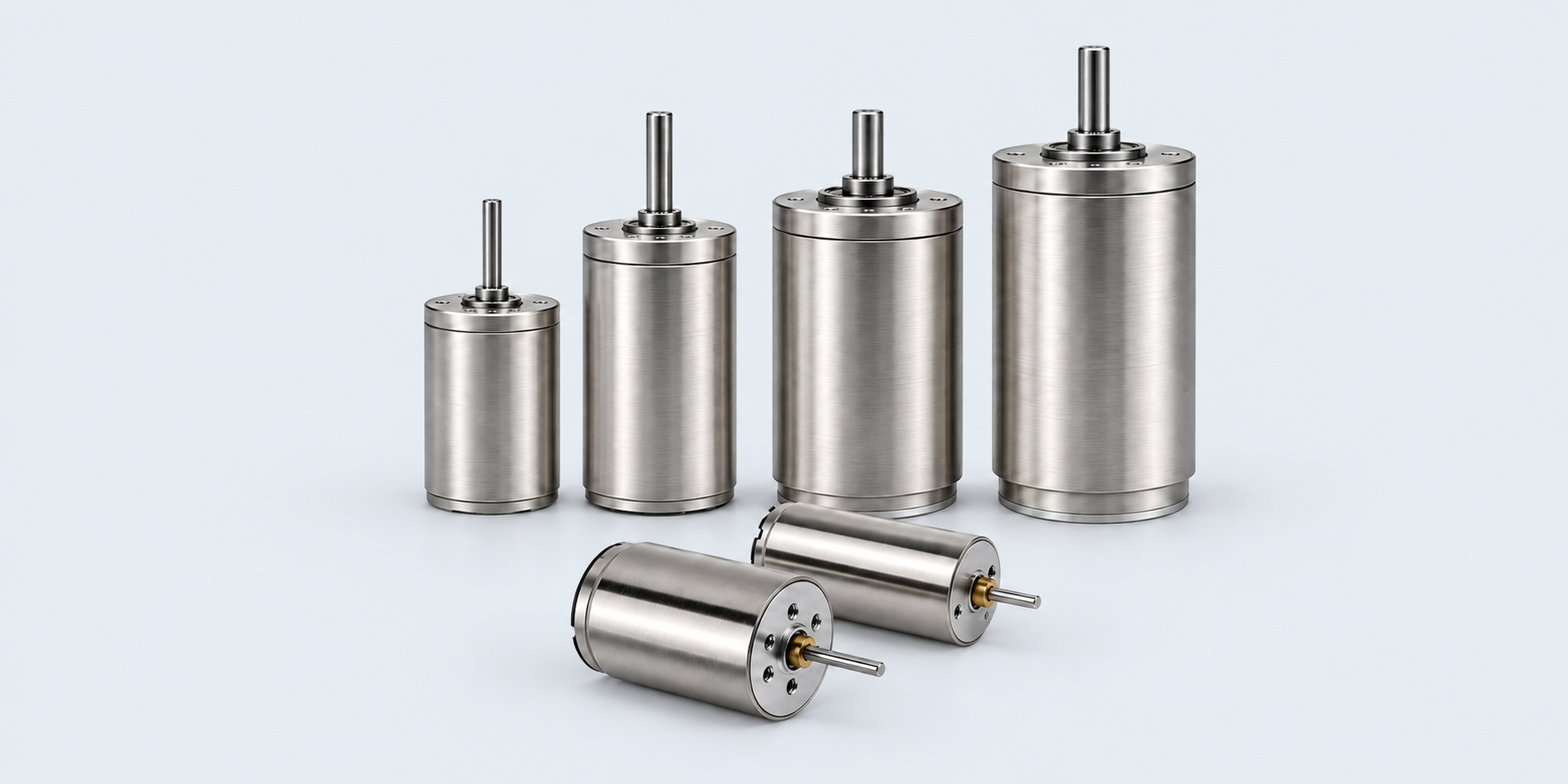
Four diameter platforms
Graphite Brush Coreless Range
The 16, 22, 26 and 32 mm platforms provide compact starting points for precision DC motion. Final length, winding and shaft configuration are selected against the operating duty.
Application-configured platform
Application-configured platform
Application-configured platform
| Motor diameter | Selection role | Final data confirmed for approval |
|---|---|---|
| 16 mm | Minimum-envelope platform | Winding, speed, torque, current, length and shaft |
| 22 mm | Compact general-purpose platform | Winding, speed, torque, current, length and shaft |
| 26 mm | Higher continuous-output platform | Winding, speed, torque, current, length and shaft |
| 32 mm | Largest standard graphite-brush platform | Winding, speed, torque, current, length and shaft |
Engineering data release: Voltage, speed, continuous torque, current, efficiency and motor length are confirmed for the selected winding and operating point. For graphite-brush configurations, SDT also reviews commutator loading, brush life, duty cycle and environmental conditions before technical release.
Graphite brush coreless motor selection guideReview the diameter platforms, selection criteria and technical-release requirements.
Technical PDFRequest Technical Datasheet →Engineering selection criteria
Select for Performance and Brush Life
The correct platform balances the required operating point with commutator loading, service life and mechanical integration. SDT records these conditions before releasing the selected configuration.
01
Define voltage and load
Confirm the available supply, target speed, continuous torque, starting load, duty cycle and direction changes.
Output: required electrical operating point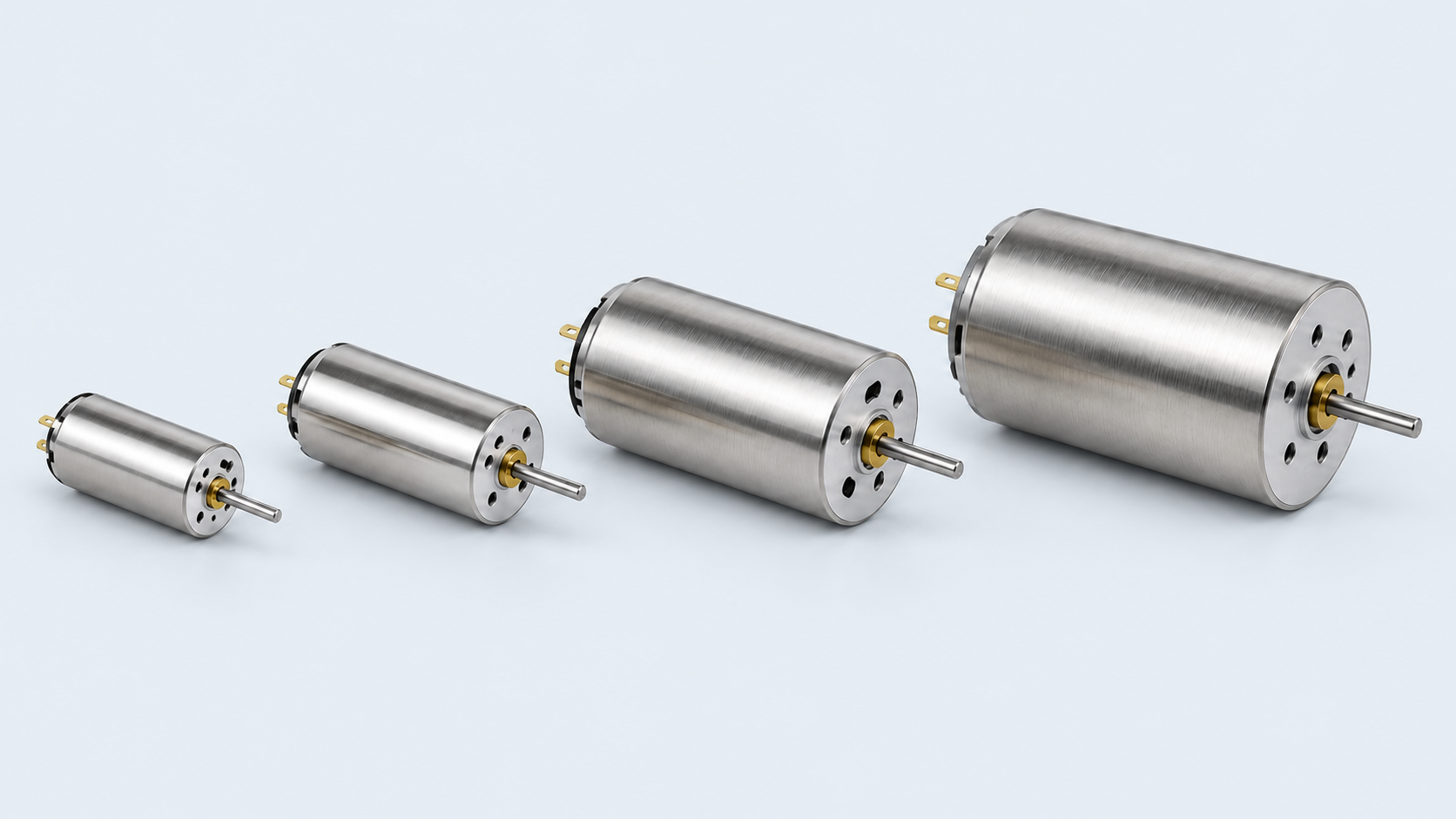
02
Check life and environment
Review brush and commutator loading, operating hours, starts, ambient conditions, vibration and contamination exposure.
Output: duty and service-life assessment
03
Configure the mechanical system
Select shaft, bearings, mounting, encoder and gearhead against the equipment envelope and output-load requirement.
Output: approved motor or geared-drive designCoreless brushed advantages
Responsive Motion Without an Iron Armature
A self-supporting winding reduces moving mass and eliminates conventional iron-armature cogging, while the graphite brush and commutator provide direct mechanical commutation.
Very low inertia
The ironless armature accelerates and decelerates rapidly with a short mechanical response time.
No cogging
The coreless construction provides smooth rotation, low starting torque and linear output behaviour.
High efficiency
A small air gap and high-performance permanent magnets support strong output from a compact package.
Simple DC control
Mechanical graphite-brush commutation allows straightforward voltage or PWM speed control.
Low vibration and noise
Smooth torque delivery supports quiet operation in compact precision equipment.
Flexible integration
Winding, shaft, bearings, connectors, feedback and gearhead can be configured around the application.
Application-led configuration
Build the Required Motor or Geared Drive
Electrical design
Voltage, winding, speed and current matched to the supply and duty cycle.
Brush system
Graphite-brush and commutator arrangement selected around load, life and operating conditions.
Mechanical interface
Shaft, mounting, housing, bearings and connectors adapted to the equipment.
Feedback
Encoder or speed feedback added where closed-loop regulation is required.
Gearhead integration
Ratio, backlash and output loading matched to the required torque and speed.
Production supply
Approved configuration and inspection requirements controlled for repeatable supply.
Define Your Graphite Brush Motor Requirement
Share the voltage, speed, torque, envelope, duty, life and output-interface requirements.